
Undisciplining the Victorian Classroom at MVSA 2027, April 1-3, 2027
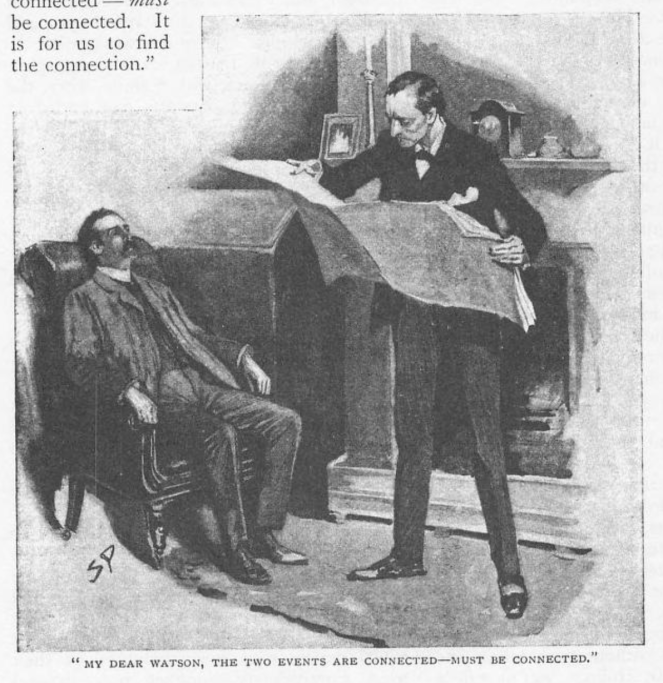
Sidney Paget, “My Dear Watson, The Two Events Are Connected,” from: Arthur Conan Doyle, The Original Illustrated Sherlock Holmes (Castle Books, 1987), p. 627.
Undisciplining the Victorian Classroom invites proposals for shorter roundtable contributions and full-length conference papers for a series of pedagogy events at the Midwest Victorian Studies Association conference in Minneapolis, MN, on April 1-3, 2027 (conference theme “Detection”).
As the profession faces ever-increasing political and material precarity, contingent faculty, non-tenure-track instructors, graduate instructors, instructors of color, and international faculty in particular are teaching under increasingly difficult labor conditions. This includes the disappearance of secure and full-time academic employment, government-backed research funding, freedom of academic inquiry, diversity initiatives, and dedicated courses to nineteenth-century studies. We invite presentations on how teachers at all levels, from graduate student instructors to early-career and established faculty, can approach teaching Anglophone nineteenth-century studies responsibly at this sociopolitical moment, considering that the academy itself appears to be doubling down on imperial logics in many places, including the promotion of the use of generative AI. We welcome papers on all topics that are related to this call. Some possible questions that these papers might explore are:
- How can the study of nineteenth-century literature or Victorian literature (broadly conceived) help students detect the working of imperial power?
- What kinds of classroom discussions, group activities, student assignments, or grading practices have helped teachers make imperial extraction intelligible to students and connect the historical past with the urgencies of the present moment, including to education and technology as embattled sites?
- How might our teaching strategies shift depending on the demographics of the students in our classrooms, including in the Midwest, such as class, immigration status, gender, race, sexuality, religion, and more?
- What are some challenges that instructors in our field and/or in the Midwest are facing? How have teachers themselves, alongside immigrants and undocumented students, been subjected to types of detection that mirror the types of scrutiny that Empire often inflicted on its colonial subjects in the nineteenth century?
- What types of learning, teaching, and mentorship are happening in sites outside of the formal site of the classroom, a site increasingly coming under detection by the academy? Where are alternative types of learning and teaching occurring and why do they matter? How might we rethink what constitutes learning, teaching, and mentorship more broadly during times of global crisis (e.g. climate change, war, techno-authoritarianism, etc.) and censorship?
- What kind of hope can we offer to students who are most impacted by the academy’s alignments with imperial logics? What kind of hope might we offer to each other? What do we need from one another to keep going? Why should we keep going?
Please send 300-word abstracts and 2-page CVs to Cherrie Kwok (cherrie-kwok@uiowa.edu) and Doreen Thierauf (dthierauf@ncwu.edu) by November 30, 2026.